


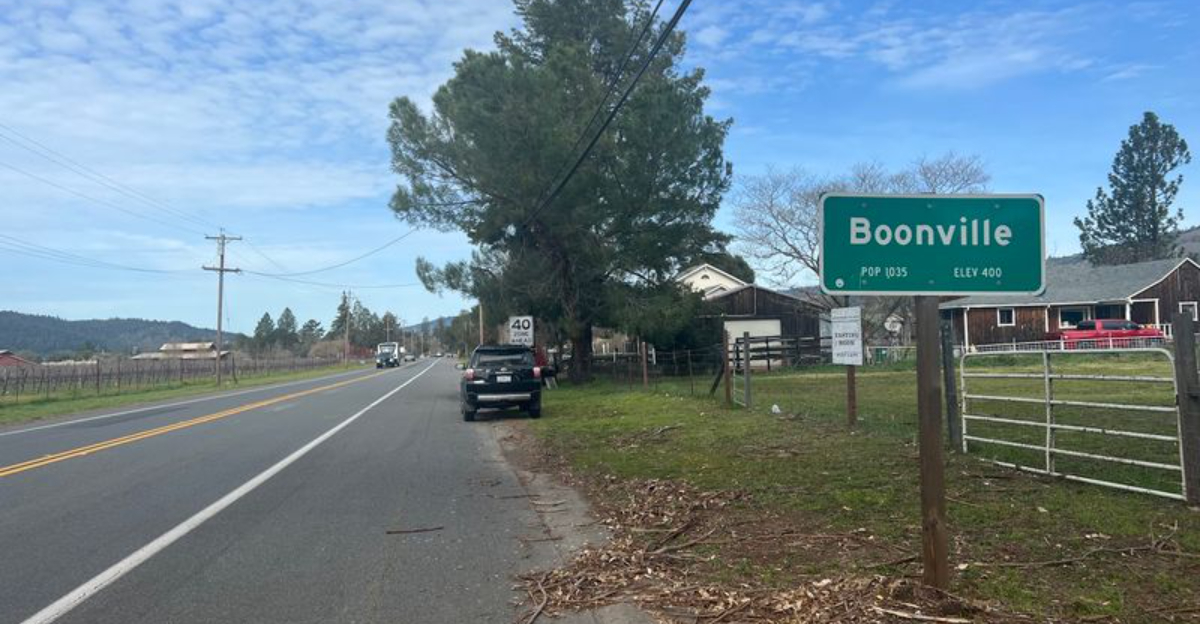
Tucked away in the rolling hills of Mendocino County, Boonville, California is a small town with a big secret. Sometime in the 1800s, the locals here created their very own made-up language called Boontling, and some people still use it today.
With a population of just over 1,000 people, this quiet little community has managed to hold onto one of the most unusual traditions in American history. If you have ever wanted to visit a place where the locals literally speak a different language, Boonville might just be the most fascinating town in the entire state.
What Exactly Is Boontling?
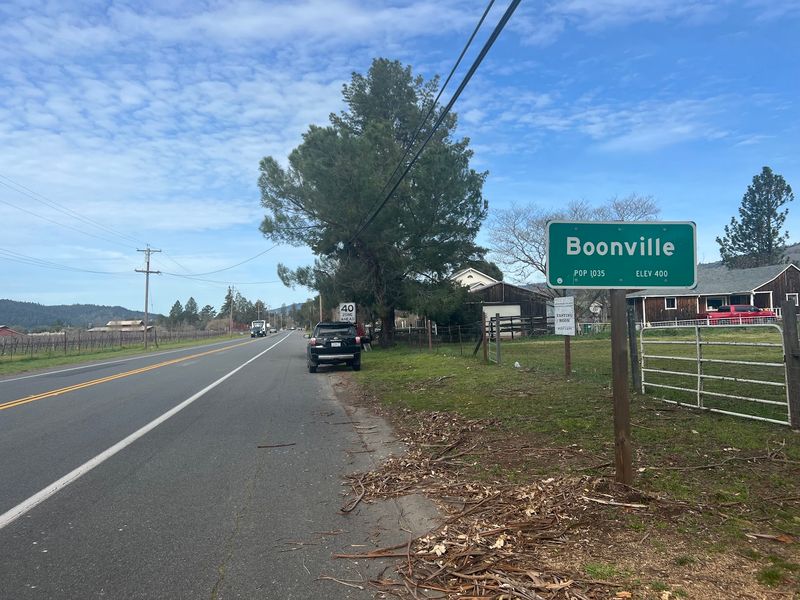
Picture a language so secret that outsiders had no idea what was being said right in front of them. That is exactly what Boontling is.
Developed in the late 1800s in Boonville, California, Boontling is a local slang dialect invented by the townspeople of the Anderson Valley.
Linguists consider it a genuine constructed dialect because it has its own vocabulary, grammar patterns, and even unique sounds. The word “Boontling” itself comes from combining “Boonville” and “lingo.” Locals would use it to gossip, joke around, and keep conversations private from visiting strangers.
Researchers have documented over 1,000 unique Boontling words and phrases. Some words were borrowed from local Native American languages, Spanish, and Scottish Gaelic.
Today, only a small handful of older residents still speak it fluently, making it a rare and precious piece of living American history.
How Boontling Got Started

Back in the 1880s, Boonville was a seriously isolated place. The dirt roads and thick forests of the Anderson Valley made it hard for outsiders to get in or for locals to get out.
That isolation became the perfect breeding ground for something unusual.
Most historians believe Boontling started as a playful game among young people, hop pickers, and mill workers who wanted a private way to chat. Some stories say women invented it so they could gossip without men understanding.
Others say teenagers created it to confuse adults.
Whatever the true origin, the language caught on fast. Families passed it down through generations, and it became a real part of community life.
By the early 1900s, nearly everyone in Boonville knew at least some Boontling. The language grew organically, picking up new words as the community changed and new characters arrived in town.
The People Who Invented the Words
One of the coolest things about Boontling is that many words were named after real people who actually lived in Boonville. Locals would take something funny or memorable about a person and turn it into a word that everyone would use forever.
For example, the Boontling word for coffee is “zeese,” named after a man called Z.C. Ball whose coffee was famously strong.
The word for a telephone is “bucky walter,” named after a local man who was one of the first to own one. Even the word for a doctor came from a real physician who served the valley.
This personal touch made Boontling feel warm and community-centered rather than just a random collection of made-up sounds. Every word had a story, and every story connected back to a real Boonville neighbor.
That human connection is a big reason the language still feels alive even today.
A Living Language With Only a Few Speakers Left
Sadly, Boontling is considered an endangered dialect. At its peak, nearly the entire Boonville community could speak it.
Today, fluent speakers are extremely rare, and most are elderly residents who grew up hearing it at home and in local gathering spots.
Linguists and cultural preservationists have been working hard to document the language before it disappears entirely. Recordings, written glossaries, and even a few short films have been created to capture as many words and phrases as possible.
Local schools have occasionally introduced Boontling lessons to spark interest among younger generations.
The challenge is that languages need daily, casual use to truly survive. Without a new generation of speakers weaving Boontling into everyday conversations, the dialect risks fading away completely.
Still, the fact that anyone speaks it at all, more than 140 years after it was invented, is genuinely remarkable and worth celebrating loudly.
The Anderson Valley – The Perfect Birthplace
Geography played a huge role in shaping Boonville’s unique culture. The Anderson Valley stretches about 25 miles through Mendocino County, surrounded by ridges and dense redwood forests that once made travel in and out quite difficult.
That natural isolation gave the community a tight-knit, self-sufficient personality.
Before paved highways arrived, Boonville residents had little regular contact with the outside world. They farmed, ranched, logged, and built a community that ran almost entirely on local relationships.
When people spend that much time together with limited outside influence, creative traditions tend to spring up naturally.
The valley is strikingly beautiful, with a mild climate that today supports world-class apple orchards and award-winning wineries. Visitors who make the scenic drive along Highway 128 are often surprised to find such a charming and historically rich community waiting at the end of the winding road through the trees.
Boontling Words You Can Actually Learn
Ready to sound like a true Boonville local? A few Boontling words are easy to pick up and genuinely fun to drop into conversation. “Zeese” means coffee, so next time you order your morning cup, try asking for a zeese and see what happens.
“Bahl” means good or nice, so if something impresses you, call it bahl. “Nonch” means uncle, “harpin” means talking, and “burlap” means to kiss. “Shoveltooth” was the Boontling nickname for Abraham Lincoln, which gives you a sense of the language’s playful spirit.
“Piked” means left or went away, and “frati” means brother. Even simple greetings exist in Boontling, making it feel like a complete and usable language rather than just a quirky list of slang.
Learning even five or ten words gives you a real connection to one of California’s most unusual cultural treasures.
The Role of Hop Picking in Spreading the Language
Hop farming was a major industry in the Anderson Valley during the late 1800s and early 1900s. Every harvest season, workers from surrounding areas would flood into Boonville to help pick hops, and those seasonal gatherings became a melting pot of personalities, stories, and language.
Boontling thrived in this environment. Hop yards were noisy, social places where workers spent long hours together, and having a private lingo added a layer of fun to the hard labor.
New words were invented on the spot and passed around like inside jokes among the crew.
The seasonal nature of hop picking also meant that Boontling got tested against outsiders regularly. If a new word confused a visitor from another town, locals knew it was working perfectly.
This playful secrecy kept the language sharp and growing. The hop yards were essentially Boontling’s classroom, and every harvest season was a new lesson.
Boonville’s Annual Boonville Beer Festival Connection
Boonville is home to the Anderson Valley Brewing Company, one of California’s most beloved craft breweries. Founded in 1987, the brewery leaned directly into the town’s quirky identity by naming many of its beers using Boontling words.
It was a marketing move that also became a genuine act of cultural preservation.
Their flagship beers include names like “Boont Amber Ale” and “Barney Flats Oatmeal Stout,” both drawing from local Boontling vocabulary and place names. The brewery even prints a small Boontling glossary on some of its packaging so drinkers can learn a word or two with every sip.
The annual Boonville Beer Festival draws thousands of visitors each year to the fairgrounds, introducing a whole new crowd to both craft beer and Boontling culture. For many visitors, it is their first introduction to the language, making the brewery an unlikely but effective ambassador for Boonville’s most famous tradition.
How Linguists Discovered Boontling
For most of its existence, Boontling was almost completely unknown outside of Boonville. That changed in 1971 when a professor named Charles C.
Adams published a detailed academic study called “Boontling: An American Lingo.” His book brought the dialect to the attention of scholars and curious readers across the country.
Adams spent years in Boonville interviewing speakers, recording conversations, and cataloging vocabulary. His research revealed just how complex and structured Boontling actually was.
Far from being random nonsense, it followed consistent patterns and had a real internal logic that linguists found genuinely fascinating.
The book sparked national media attention, and suddenly little Boonville was featured in newspapers and magazines from coast to coast. Locals had mixed feelings about the spotlight.
Some were proud, while others felt the secrecy that made Boontling special had been permanently broken. Either way, Adams saved a huge piece of the language before it could fade away unrecorded.
Visiting Boonville Today
Boonville today is a welcoming, laid-back destination that rewards curious travelers. The town sits along Highway 128 about 30 miles from the Pacific Coast, making it a popular stop on road trips between San Francisco and the Northern California coast.
The drive through the Anderson Valley is genuinely one of the prettiest in the state.
Visitors can stop at local wineries, taste award-winning Pinot Noir and Gewurztraminer, and browse the small shops along the main street. The Boonville Hotel is a charming boutique inn that captures the valley’s relaxed, artsy spirit perfectly.
Local restaurants often highlight fresh, seasonal ingredients grown right in the valley.
Keep an eye out for Boontling references around town. Some signs, menus, and business names still use the old dialect words as a nod to local heritage.
Picking up a small Boontling glossary from a local shop makes for one of the most unique souvenirs you can find anywhere in California.
The Influence of Native American Languages on Boontling
Boontling did not develop in a cultural vacuum. The Anderson Valley was originally home to the Pomo people, a Native American group with a rich and complex linguistic tradition.
When European settlers arrived and the communities began interacting, some Pomo words and sounds found their way into the developing Boontling dialect.
Linguists who studied Boontling noted that certain phonetic patterns and a handful of vocabulary items appeared to have Pomo roots. This cross-cultural blending gave Boontling a depth that purely invented languages often lack.
It was not just creative wordplay but a genuine reflection of the valley’s layered cultural history.
Recognizing this indigenous influence is an important part of understanding what Boontling really represents. The language is not just a quirky local novelty but a living record of how different communities came together, clashed, cooperated, and ultimately shaped each other in a remote California valley over more than a century of shared history.
Why Secret Languages Are More Common Than You Think
Boontling is unusual, but the idea of a community inventing its own private language is actually not as rare as you might expect. Throughout history, isolated or marginalized groups have created secret codes and dialects to communicate safely among themselves.
Cockney rhyming slang in London is one famous example.
Pig Latin is a playful version most American kids learn on playgrounds. Thieves’ cant was used by criminals in medieval Europe to avoid detection by authorities.
Some languages, like Polari used by the LGBTQ community in mid-20th century Britain, served as a genuine survival tool in hostile environments.
What makes Boontling stand out is that it was created for fun rather than survival. It was born out of community spirit, creativity, and a shared sense of humor.
That joyful origin story gives it a warmth that many other secret languages simply do not have, making it one of the most endearing linguistic oddities in American cultural history.
Keeping Boontling Alive for Future Generations
The future of Boontling depends almost entirely on whether younger people choose to carry it forward. A few passionate locals have made it their personal mission to keep the language alive through community events, school visits, and online resources.
Their enthusiasm is infectious and genuinely inspiring.
Some Anderson Valley residents have created short video tutorials and social media posts teaching Boontling words to a global audience. The internet, surprisingly, might be one of Boontling’s best hopes for survival.
A language that was once secret and local can now reach curious learners in every corner of the world.
Local organizations have also worked to include Boontling in cultural festivals and historical tours of the valley. Every new person who learns even a single Boontling word becomes a tiny thread in the language’s ongoing story.
Boonville may be small, but its contribution to American linguistic history is something truly worth remembering and sharing with everyone who will listen.
Enjoyed this story?
Add Fast Food Club as a preferred source to see more of our reporting on Google.